EFFICIENCY VS. SENSITIVITY
WHAT ABOUT DIRECTIVITY VS DISPERSION?
Fred, the sound man, in spite of being as strong as an ox, and an expert driver, (he once came in second at the Marty Robbins Steer Wrestling and Go-Kart Grand Prix in El Paso) develops the annoying habit of turning everything you say into a discussion of sound reinforcement. Seeing as how the two of you are cooped up in Fred’s 2002 Econoline van for the long drives between one-nighters, your nerves are beginning to fray.
Along about 3 o’clock one morning on the outskirts of Buckatunna, you say, “I’m starving. Let’s whip into a burger joint and snag a sack of sliders.”
Fred replies, “That reminds me of how some speakers consume a lot of power. Did you know…”
“Shut up!” you shout. Fred’s a great guy, but enough is enough. “Can’t you talk about anything besides sound?”
Fred, looking wounded, mumbles, “You don’t have to be so sensitive.” After a few seconds of sullen silence, he says, “And speaking of sensitive, did I tell you about the difference between speaker efficiency vs sensitivity? Let’s begin by covering a few of the basics. Speaker Efficiency vs sensitivity are related but separate properties. The fact that both are stated in dB often adds to the confusion.”
Realizing the futility of your cause, you try not to think about food as Fred rambles through town without realizing he’s passed the one and only all night eatery talking about speaker efficiency vs sensitivity.
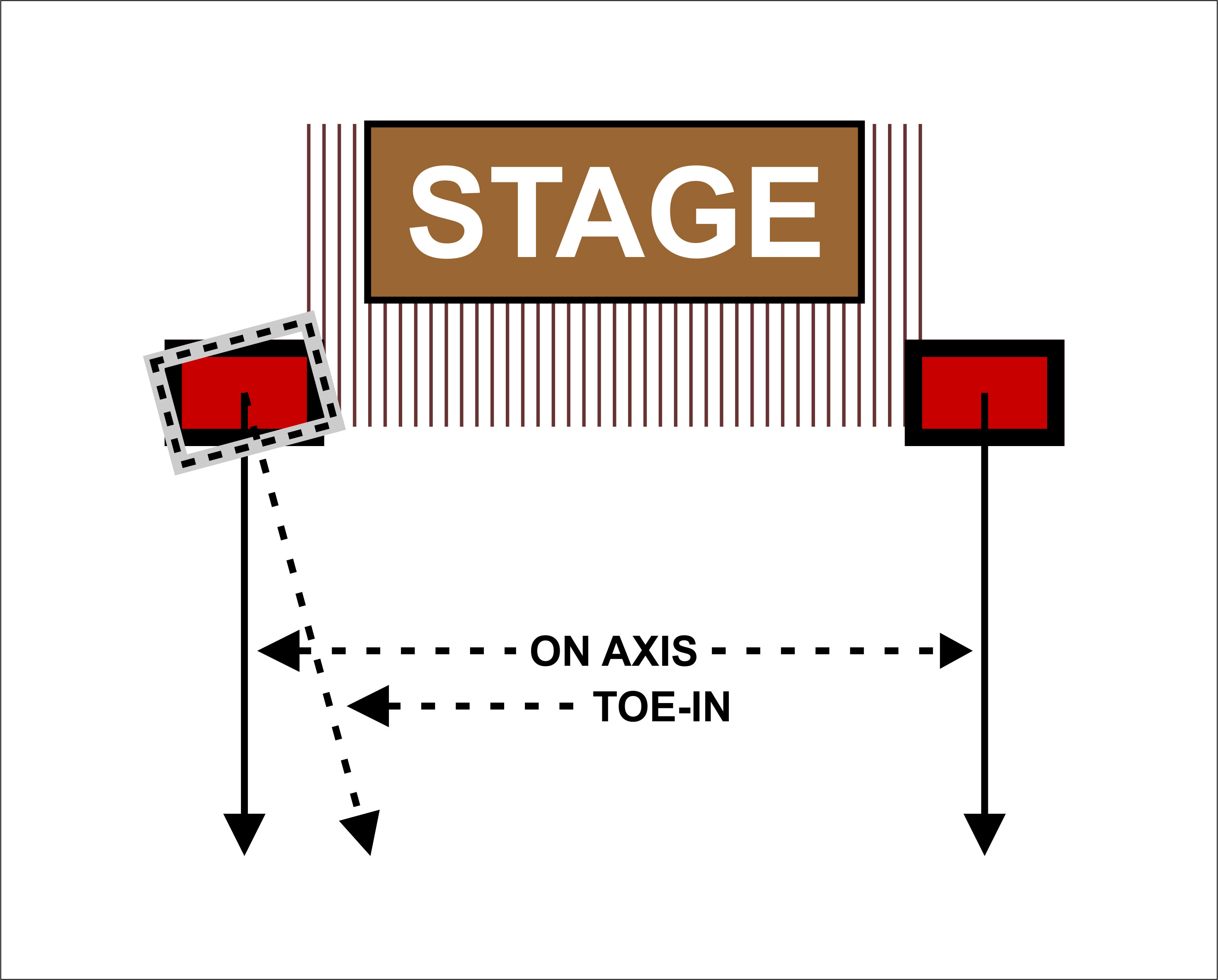
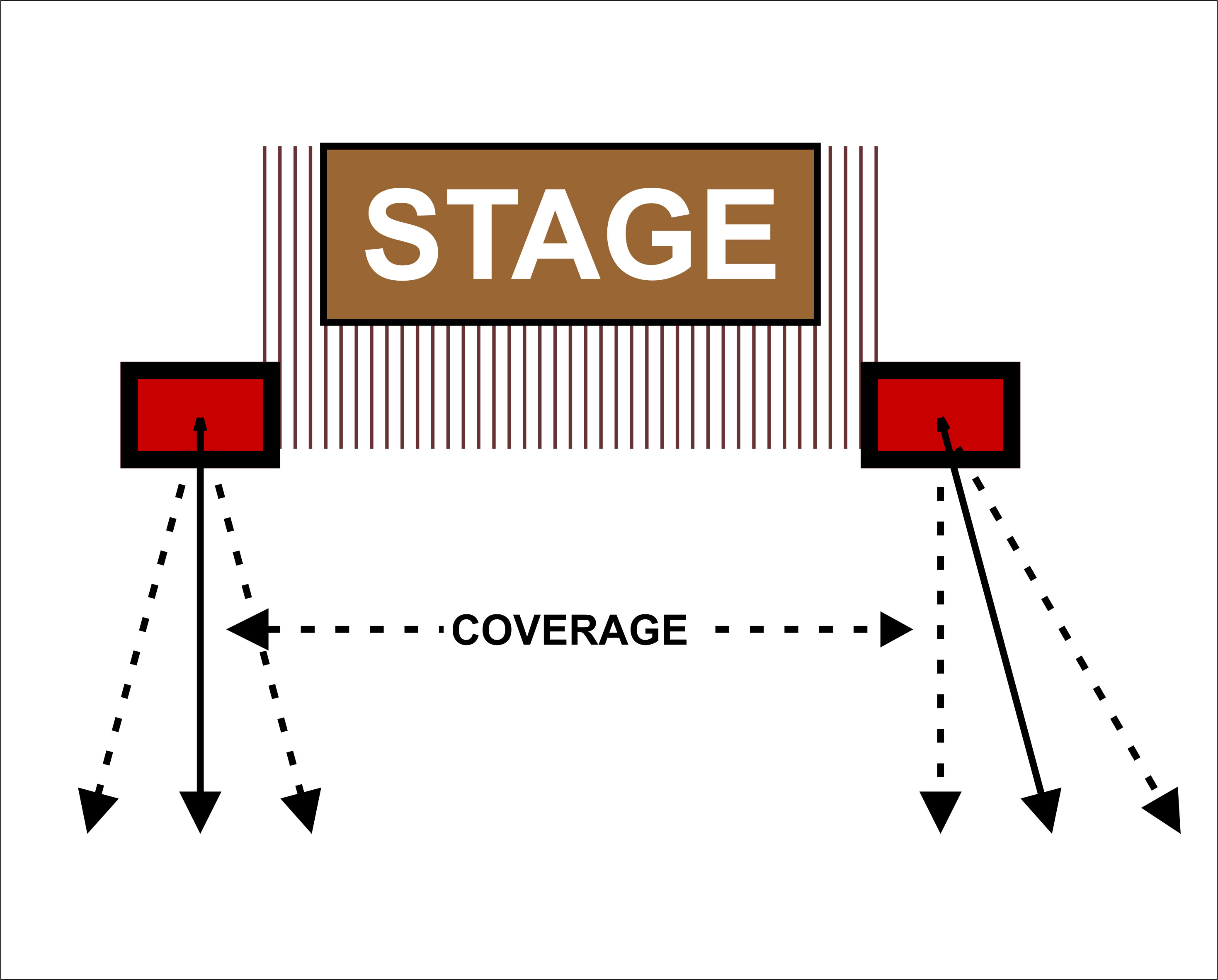
“Think of a speaker as pivoting from side to side on its vertical axis and tilting up and down on its horizontal axis. The spot directly in front of the speaker (on-axis or at 0 [zero] degrees) serves as the point of reference in discussions of coverage angles and/or sensitivity.” He continues, “A speaker’s angle of dispersion is measured in comparison to both its horizontal and vertical axes. Coverage angle describes the area blanketed by the sound pressure waves produced by a speaker. The edges, or limits, of the area are defined by a 6 dB drop-off in sound pressure from on axis.
“Q (the directivity factor) is a ratio obtained by complex mathematical calculations involving the relationship of a speaker’s direct radiated energy to its total radiated energy. When measured on axis, Q (which is dependent on frequency) is used to determine a speaker’s suitability for a particular application.
“Sensitivity is the level of sound pressure directly in front of the speaker (on axis), at a given amount of power, at a given distance (Example: 100 dB @ 1 watt @ 1 meter). Most speaker specifications pertain to sensitivity.
“Efficiency is the percentage of acoustic energy radiated in all directions from a speaker, compared to the input of a given amount of power (3% to 4% efficiency is typical for a woofer). Given two speakers with identical sensitivity and the input of an identical amount of power, the speaker with wider dispersion is more efficient.” Fred pauses long enough to ask, “Are you with me so far?”
Fred, however exasperating, knows his business. And since the growling of your stomach is keeping you awake anyway, you ask, “What about the relationship between amplifier power, sound pressure levels, and actual loudness? Will a 200 watt amp produce twice the SPL of a 100 watt amp?”
Cheered by his newly attentive audience, Fred explains, “To achieve a 3 dB increase in sound pressure requires twice the amount of power from the amplifier. So if one speaker is 3 dB more sensitive than another, the less sensitive speaker will require twice as much power to achieve the same sound pressure level (on axis) as its more sensitive counterpart. An increase of 6 dB is equal to twice the sound pressure. An increase of 10 dB produces twice the perceived loudness.”
“So,” you observe, “doubling the size of my system will increase the loudness by only 3 dB.”
“That’s exactly right.” Fred says, “Sound can be divided into two types of speakers: direct sound speakers, in which sound emanates from the cone or horn, and reverberated sound, which is reflected off of the walls and other surfaces within a room. As you move further away from the speaker, direct sound grows fainter. The point at which the SPL of reverberated— or reverberant— sound is equal to that of direct sound is called the critical distance. Coverage angle differences and other factors mean horns and cones can have different critical distances. Beyond the critical distance is an area known as the reverberant field in which there is no further decline in sound pressure levels. In the reverberant field, the SPL is influenced more by the speaker’s efficiency than its sensitivity.
“You’re in a reverberant room; let’s make it a hockey arena. Near the speakers, the sound is good, but as you move farther away, it’s bassy. The horns are more sensitive than the woofers. The woofers are more efficient than the horns. To achieve a flat frequency response (in which the bass, mids and highs are at the same volume) the horns have been shelved at the crossover, meaning the signal going to the horns has been adjusted to compensate for the difference between their sensitivity and that of the woofers. The on-axis SPL of the horns and woofers is equal. The woofers’ critical distance is 20 feet and the horns’ is 30 feet. Beyond 20 feet from the woofers (in their reverberant field) there is no further reduction in their SPL. At 20 feet from the horns, you’re still hearing direct sound which, as you move away, continues to decrease (according to the inverse square law) until you reach their critical distance. To be heard as easily as the bass frequencies, the mids and highs require more and more power.
Fred continues, “Outdoors, without the influence of walls, ceilings, and other surfaces, there is virtually no reverberant field, so SPL’s continue to drop as you move away from the source, until the sound disappears into the noise floor.”
You ask, “Should the sound system be tailored with different types of speakers to suit the venue?”
Fred replies, “Yes. Take, for instance, choosing between high Q speakers and low Q speakers. Remember, your goal as a sound man (or sound woman) is to make sure everyone in the room, no matter where they’re sitting, can clearly hear and understand what is coming out of the speakers. You don’t want part of the audience hearing only direct sound and the others hearing only reverberant sound. The coverage throughout the room should be as uniform as possible using different types of speakers.”
Finding a half-eaten bag of barbecued pork rinds under your seat, you say, “Tell me more,” and tuck hungrily into your snack.
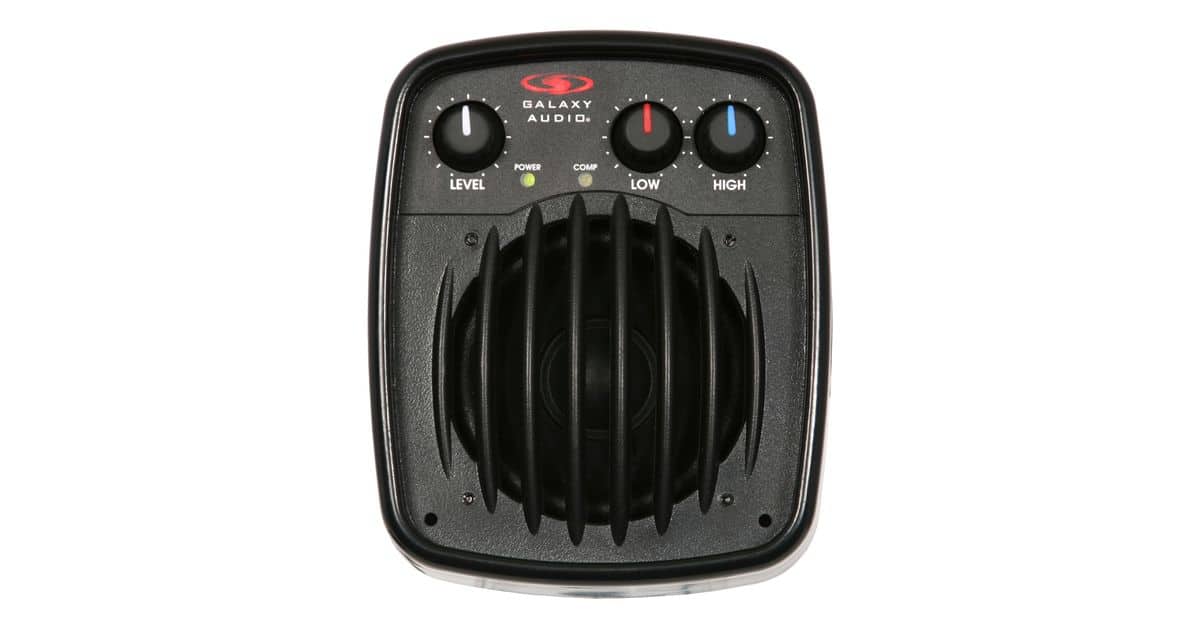
Happy to oblige, Fred continues. “In a room with short reverb times (a small church, for example) a low Q speaker, like Galaxy Audio’s CR12, works better. Its larger sonic footprint allows the reverberant field to cover the area not in the direct field, so that a similar quality of sound is heard by the entire audience. In a room with long reverb times (a large church, for example), a high Q speaker, like the CR15, is better. Its tight coverage angle washes the audience in direct sound and reduces apparent reverb time.”
You ask, “Does anybody design and build speakers that are sensitive and efficient?”
“Of course,” says Fred. “that’s what Galaxy Audio has been doing since 1977. Now can I have one of those pork rinds?”